From the Nile
to the Neural Network.
Egyptian Mathematical Traditions and Their Foundational Role in Modern Generative AI. Four mathematical threads, traced across 3,400 years, from the Rhind Papyrus to the transformer architecture.
Concept by Eamon Moore FCCA MSc Accountancy, PetroMove AI Ltd
Research by Claude™ (Anthropic™) · March 2026
Did Ancient Egypt Plant the Mathematical Seeds of Generative AI?
The Algebra
Did the symbolic algebra of Diophantus and Abu Kamil give rise to the embedding vectors that power large language models?
The Geometry
Did Hypatia's angular geometry and Eratosthenes' spatial calculations become the cosine similarity that drives vector search?
The Algorithm
Did Eratosthenes' Sieve and Ahmes' fraction decomposition evolve into the ANN search and semantic chunking of modern RAG pipelines?
The conceptual lineage is unbroken across four mathematical threads and 3,400 years. Not a claim of direct causation — a claim that the ideas modern AI depends on were first posed, and first solved, in the ancient Mediterranean world.
Seven Scholars Whose Work Flows, Unbroken, Into Every Modern AI System
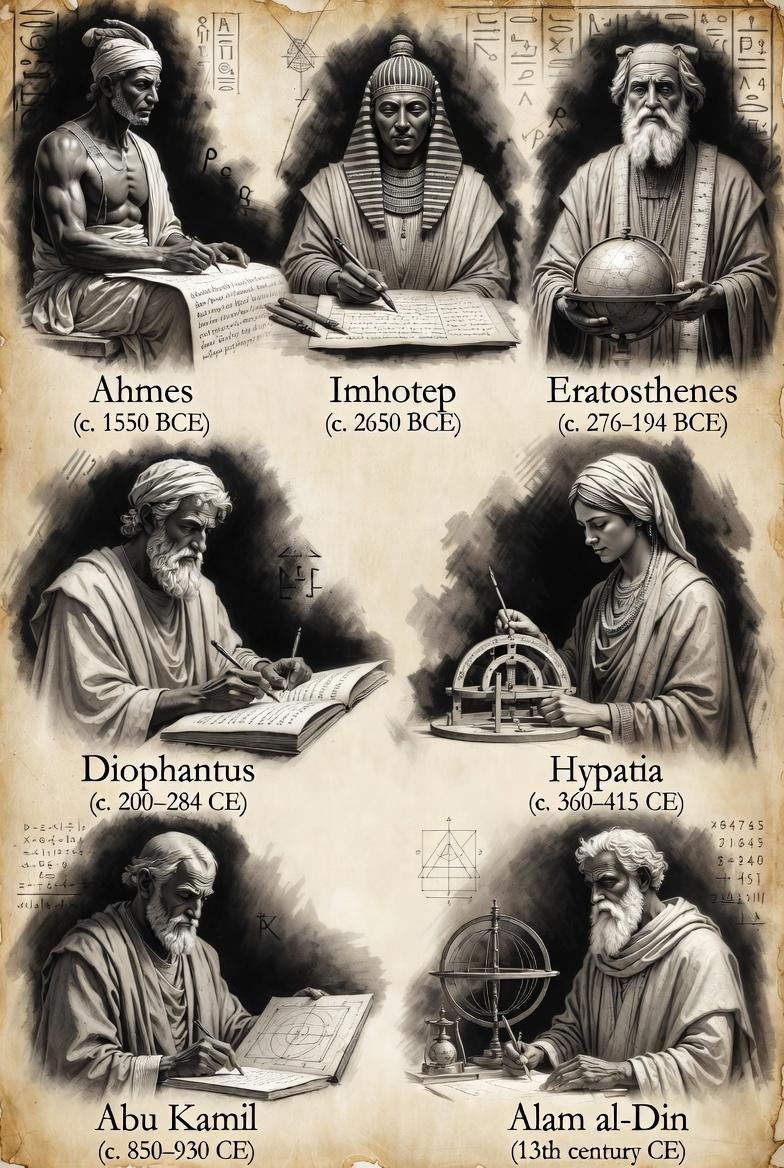
Artistic renderings. No contemporary likeness survives for any of these figures.
Algebraic Symbolism → Embeddings & Latent Space
An embedding, as Databricks™ documentation describes it, is an array of floating-point values that carries semantic meaning. That is Ahmes' unit-fraction principle — encoding a complex whole as structured numerical components — expressed in Diophantus' symbolic framework, at the scale Al-Khwarizmi's procedural algebra made possible.
Spatial Geometry → Distance & Similarity Metrics
Numerical Algorithms → ANN Search & Semantic Chunking
Astronomical Coordinate Systems → High-Dimensional Embedding Spaces
The celestial globe and the vector index are the same mathematical object: a metric coordinate space where complex entities are encoded as numerical points and retrieved by spatial proximity.
The Library of Alexandria ≡ Retrieval-Augmented Generation
Library of Alexandria (c. 295 BCE): A scholar poses a question. Librarians search the indexed scroll collection for relevant material.
Modern RAG: The system searches an indexed knowledge base for the data chunks most relevant to the query.
Library of Alexandria: Relevant scrolls are retrieved and placed before the scholar — injected into their reasoning environment as context.
Modern RAG: Those retrieved chunks are inserted directly into the model's context window.
Library of Alexandria: The scholar synthesises a response — a commentary, a proof — grounded in retrieved material, not unaided internal memory.
Modern RAG: The model composes its answer from the injected material rather than from parametric memory alone.
Same architectural pattern. Same epistemological problem. 2,320 years apart.
How the Alexandrian Corpus Reached the Modern AI Mathematical Substrate
Four Mathematical Threads · 3,400 Years · One Unbroken Chain
“Every matrix multiplication we perform, every attention head, every gradient descent step — all of it ultimately flows from that same ancient river of human curiosity.”
The well is deep.
Discuss This With Us →Concept: Eamon Moore FCCA MSc Accountancy, PetroMove AI Ltd
Research: Claude™ (Anthropic™)
Portraiture: Grok (xAI)
March 2026